
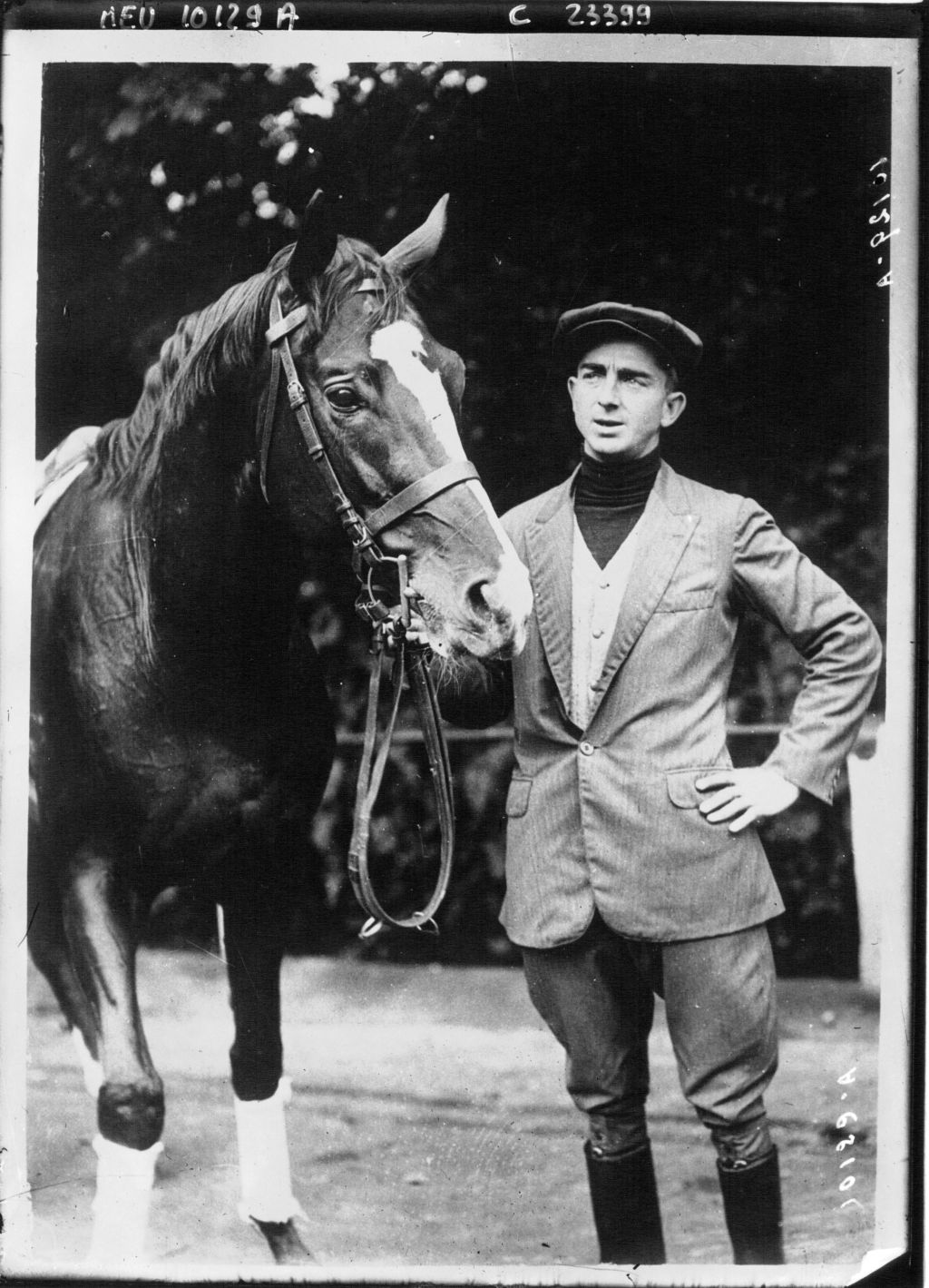
Story of Épinard Is a Romantic One
The story of Épinard is one of the most fascinating romances in the history of Thoroughbred breeding. Although Pierre Wertheimer had been racing horses as early as 1909 in partnership with his brother, it was not until shortly before the war that he made up his mind to begin breeding horses of his own.
On the advice of the late Chéri-Halbronn, a leading authority on horse breeding, Wertheimer acquired two shares in a syndicate of breeders that had imported to France from the United States the English stallion Rock Sand, winner of the Epsom Derby in 1903.
Unfortunately, Rock Sand died only two years after his arrival in France, and the outbreak of war soon brought racing activity almost entirely to a standstill. Breeders and racehorse owners were faced with a grave situation. Feed for horses, when obtainable at all, was prohibitively expensive, and there was little prospect of financial return. Matters worsened further with the German advance of 1918, which compelled many breeding and racing establishments to move their horses to the south of France.
At this time, August Belmont—who had raced and bred horses in France for many years—decided to remove the bulk of his stock to the United States, offering those that remained for sale in Paris. The catalogue of this dispersal sale came into the hands of Pierre Wertheimer, who was then serving with the French Army near Paris.
The young sportsman held two firm principles regarding breeding. He believed strongly in the value of Rock Sand blood, as demonstrated by his support of that stallion’s importation, and he was equally convinced of the need to rejuvenate traditional French bloodlines through the judicious introduction of foreign—particularly American—blood. He had closely observed the success on the French turf of horses owned by W. K. Vanderbilt and H. B. Duryea, many of which were bred along these lines.
Bought Dam for $400
Wertheimer instructed a friend to bid on two mares at the Belmont sale. One was Bivouac, an aged American mare by Ethelbert out of Hastings, and the dam of the successful Belmont runner Bavard III. The other was Épine Blanche, a daughter of Rock Sand out of the American mare White Thorn, by Nasturtium.
Bivouac was purchased for $350, while Épine Blanche was secured for $400.
Épine Blanche was sent to Badajoz, a stallion owned by a relative of Mrs. Wertheimer, Michel Lazard. Badajoz, by Gost-Selected, had been a fair performer on the turf but proved only a moderate success at stud. In foal to Badajoz, Épine Blanche was then sent to the Haras de Bessan, Wertheimer’s newly established stud farm in the southwest of France, approximately fifty miles from Bordeaux.
Establishing a breeding operation so far removed from the fashionable stud regions was a bold and unconventional decision. Nevertheless, the pastures of Bessan soon proved invaluable. Owing particularly to the calcareous nature of the soil, it was discovered that horses raised on Bessan grass commonly developed exceptional strength of bone.
As Épine Blanche was still an unproven broodmare, Wertheimer did not consider it worthwhile to enter his colt in the classic races, with the sole exception of the Poule d’Essai.

 Equus Chronicles
Leave a comment